


Imurenge.com
Loading...
Welcome ! Preparing Your experience ..
Welcome ! Preparing Your experience ..
May 19, 2026nationalinternationalpoliticseducation#breaking-news
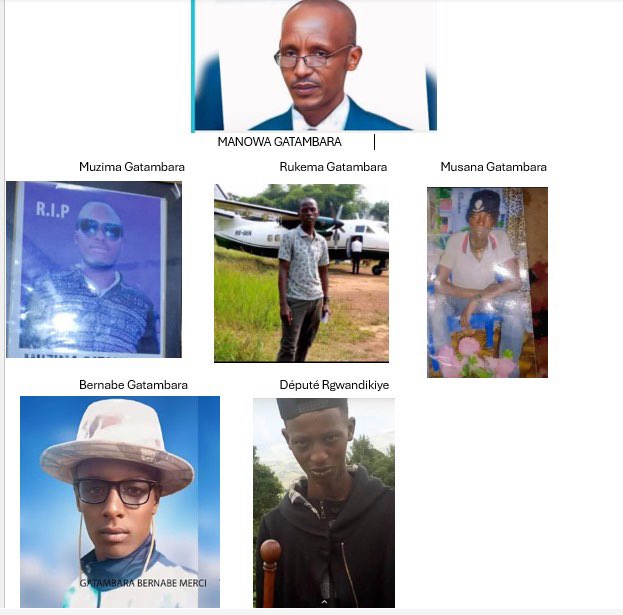
MINEMBWE, DR CONGO - In the hills of Minembwe and the surrounding areas, life for many innocent families has become a daily struggle shaped by fear, uncertainty, displacement, hunger, and repeated waves of violence. For years, civilians have lived through attacks, the loss of loved ones, destruction of homes, and the heavy emotional burden of never knowing where danger will come from next.
Behind every report emerging from eastern Democratic Republic of Congo are real human lives. Families carry pain that words can hardly capture. Children grow up in the middle of conflict, mothers are forced to bury their sons, and elders witness entire family lines slowly being erased.
Among these families is the Gatambara family from the Banyamulenge community, belonging to the Abasinga clan.
Once known as a large and respected lineage, the Gatambara family has, in a painfully short time, been reduced through a series of repeated losses. Relatives describe it as a slow disappearance, not a single moment of tragedy, but a chain of killings that has stretched across years and left deep wounds that never heal.
Since 2016, six sons and grandsons of the Gatambara family have been killed in separate incidents linked by relatives to ongoing insecurity involving Mai-Mai militias, Red Tabara elements, and, in some accounts, members of the FARDC.
Mai-Mai, referred to in certain contexts as “Wazalendo,” are local armed groups that have operated in eastern Democratic Republic of Congo for many years. Although the term “Wazalendo” is often used to describe community-based self-defense fighters, in practice it includes different factions with varying structures, leadership, and alliances. However, reports and testimonies from affected communities allege that some of these groups have been involved in violence against civilians.
For those left behind, each loss did not bring closure. Instead, it opened a new wound before the previous one had even begun to heal.
MUZIMA, son of Ngirisoni and grandson of Gatambara, was killed on 29 May 2016 in Bijumba (Mubijumba), Kalingi, in an attack attributed to Mai-Mai fighters.
MUSANA, son of Manoa and grandson of Gatambara, was killed in August 2017 in Salamabila during violence linked to Mai-Mai militias known as the Wazalendo, today.
RUKEMA, son of Gatambara, was killed on 2 June 2022 in Kwirumba village, Minembwe, during an attack reportedly involving a Mai-Mai and Red Tabara coalition.
BARNABE, son of Sebicinzara and grandson of Gatambara, was killed on 25 December 2024 in Evomi "Ecole Vétérinaire" (Veterinary School), Minembwe. Relatives have attributed responsibility to FARDC forces.
DEPITE, son of Zebedayo and grandson of Rwandikiye, the brother of Gatambara, was killed on 17 April 2025 in Rugezi during an attack by Mai-Mai.
MANOA, son of Gatambara, was killed on 16 May 2025 in Kuwanyamiringa, Minembwe, also in an attack attributed to Mai-Mai elements.
For many Banyamulenge families, the experience of the Gatambara family is not an isolated case, but part of a broader reality that continues to unfold in Minembwe and surrounding areas.
People speak of repeated attacks, displacement, shortages of food, limited humanitarian access, fear of drone strikes, and the constant challenge of survival in isolated communities. Many feel forgotten, as though their suffering has become invisible to the outside world.
Relatives of the Gatambara family now live with a fear that goes beyond grief, the fear that an entire family line could eventually disappear if the violence continues.
What remains is not just a list of names, but human lives that once had futures, dreams, and relationships. Fathers, sons, brothers, and grandsons whose absence is felt every single day.
For those who remain, the pain is not political. It is lived quietly, personally, and relentlessly.
Across the community, calls continue for protection of civilians, accountability for killings, humanitarian access, and a lasting peace that can break the cycle of loss.
Above all, there is a shared hope that this kind of suffering does not become accepted as normal, and that every civilian, regardless of where they come from, has the right to live in dignity and without fear.
Note: Stories like these are not shared to promote hatred or discrimination. They are shared to document the violence and suffering endured by civilians in Minembwe and surrounding areas. The aim is to educate the next generation about the history faced by their ancestors and to encourage reflection so that such tragic events are never repeated again.

____
Source of this article was provided and approved by members of the family, and originally retrieved from an activist account: Original source on X (Twitter)

