

Imurenge.com
Loading...
Welcome ! Preparing Your experience ..
Welcome ! Preparing Your experience ..
April 26, 2025politicseducationscience#analysis
The Banyamulenge tribe in the Democratic Republic of Congo (DRC) has been specifically targeted and persecuted since the 1960s. Their situation worsened in the 1990s when local armed groups, particularly the Mai-Mai militias, branded them as “invaders.”
The interlinked conflicts in eastern DRC are driven by a deadly combination of ethnic, political, and community tensions. Among the principal perpetrators of genocidal massacres are the Mai-Mai militias, which have been systematically targeting and attacking the Banyamulenge ethnic minority in well-organized operations. In an area ravaged by insurgencies, ethnic militias, and widespread violence, the specific targeting of Banyamulenge individuals is often obscured by the generalized chaos.
This is not random violence; it is calculated and intentionally planned.
Historically, state officials and religious figures have played a pivotal role in inciting violence against the Banyamulenge, including open calls for their extermination.
Senior government officials such as the former Governor of South Kivu, Lwasi Ngabo Lwabanji, issued a six-day ultimatum in October 1996, demanding that the Banyamulenge leave the region or be treated as rebels and subjected to military action.
On October 11, 1996, Zaïre Army Chief of Staff General Eluki Monga Aundu called on youth to join the army to hunt down the Banyamulenge.
Members of President Laurent-Désiré Kabila’s inner circle, including Abdoulaye Yerodia Ndombasi, referred to the Banyamulenge as "vermin" and called for their extermination.
Religious authorities, such as Catholic Church Bishop Christophe Munzihirwa, also contributed to the incitement, comparing the Banyamulenge in 1996 to snakes that must be killed.
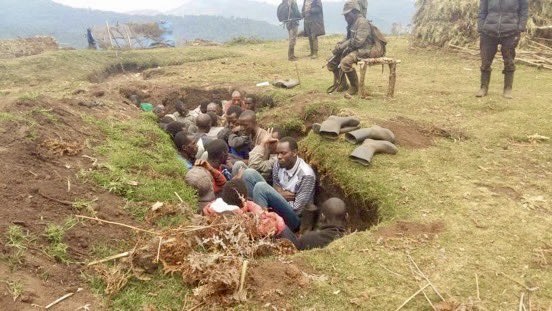
These declarations were often followed by organized massacres and mass killings, where unarmed military personnel were systematically rounded up and executed alongside civilians. Men and boys were typically marked and separated to be executed first.
Since 2017, the Banyamulenge have been quietly suffering a slow genocide that the international press has largely ignored. They have been systematically targeted by a growing coalition of Banyindu, Bafuliro, and Babembe Mai-Mai militias, Burundian rebels known as Red Tabara, and Mai-Mai groups such as Biloze Bishambuke, which means, “If we have to destroy, let’s destroy.”
In Baraka, South Kivu, on January 17, 2020, a young militant from the Congolese Lamuka opposition coalition incited a hate-filled frenzy among a crowd. He gave the Banyamulenge 48 hours to leave the DRC, stating that those who refused to leave voluntarily should be forced out, and anyone who helped Rwandophones should be treated as an enemy.
William Amuri Yakutumba, a self-proclaimed general, gained local political support by being openly hostile to Congolese of Rwandan descent, claiming former President Joseph Kabila was a hostage to foreign powers who oppressed the native Congolese.
A 2021 report by Human Rights Watch revealed that violence continued to escalate in eastern DRC’s Ituri and North and South Kivu provinces. According to the Armed Conflict Location and Event Data Project (ACLED), over 1,000 people were killed since January 2021 alone. In South Kivu, the government army, militants, and local militias continue to target the Banyamulenge minority.
A report from the UNJHRO in March 2021 found that 80 percent of all hate speech in the DRC was ethnically motivated, with 31 percent specifically targeting the Banyamulenge tribe.
Most ordinary Congolese still blame the Banyamulenge for the country’s suffering since 1998, viewing them as a Trojan Horse for Rwandan exploitation and territorial ambition. This perception fuels the deep polarization around the nationality question.
Besides the physical attacks, mentioned above since 2017, Banyamulenge have fled to neighboring countries, while those remaining in the Hauts Plateaux have retreated to small, impoverished localities besieged by the government army. Basic needs like medicine and food have been cut off to these few remaining villages. Attacks have nearly destroyed rural settlements, social infrastructures, cattle, and crops.
Equally concerning is the ongoing effort to obscure or erase evidence of these atrocities. Despite changes in political leadership over time, the ideology driving the persecution has remained consistent, rooted in narratives established during the Simba rebellions of the 1960s. This ideology has been openly embraced by the Congolese elite, particularly in South Kivu, and issued in official documents presented at national peace and reconciliation processes.
These elites continue to deny the Banyamulenge’s Congolese identity, reinforcing the Mai-Mai’s claims that they are invaders who must be expelled.
According to genocide scholars, there is clear intent to annihilate the Banyamulenge, a case of organized group annihilation that constitutes genocidal intent.

