


Loading...
April 20, 2025politics#feature
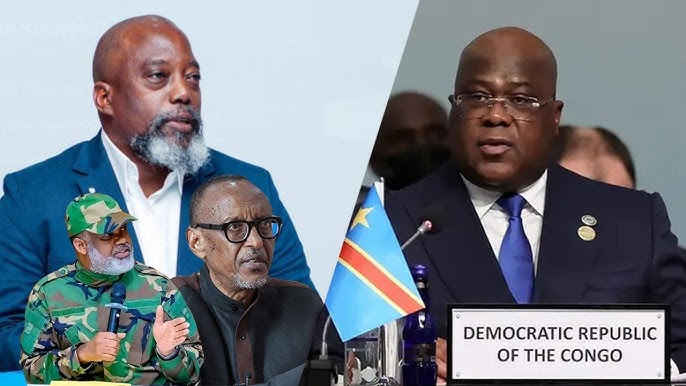
GOMA, DRC (April 19, 2025)
Tensions in the Democratic Republic of Congo have surged following the unexpected return of former President Joseph Kabila to the rebel-held city of Goma. The Congolese government has now officially launched legal proceedings against him, accusing the ex-leader of high treason for allegedly supporting the M23 rebel group and its political arm, the AFC.
Kabila, who ruled the country from 2001 to 2019, is said to have re-entered the DRC through Rwanda, making his way to Goma, currently under the control of the M23. This development has deepened fears of political upheaval in a region already overwhelmed by violence, displacement, and mounting instability.
Justice Minister Constant Mutamba announced the opening of an investigation into Kabila’s alleged role in fueling the rebellion, ordering both the military’s top inspector and the Supreme Court’s prosecutor to begin legal procedures. The government also suspended operations of Kabila’s political party, the People’s Party for Reconstruction and Democracy (PPRD), across the country.
Mutamba accused Kabila of playing a direct role in the acts of aggression carried out by Rwanda through its proxy group, AFC/M23. Meanwhile, Kabila has remained silent on both his return and the government’s accusations.
In an interview with the BBC, M23 spokesman Lawrence Kanyuka confirmed Kabila’s presence in Goma, adding, “I don’t see any problem with that.” His calm tone contrasts sharply with the growing alarm in Kinshasa, where officials worry Kabila’s return could embolden rebel forces and shift the balance of power in the volatile east.
Kabila’s reappearance has stunned many, especially as his last known visit to the DRC was in December 2023, before the general elections. Since then, his spokesperson claimed he had been pursuing academic studies at a university in Johannesburg, South Africa. However, his activities abroad have remained under scrutiny from President Félix Tshisekedi’s government, which suspects Kabila of maintaining ties with rebel figures, including former electoral commission head Corneille Nangaa.
The situation has now reached a boiling point. Authorities have requested the seizure of both movable and immovable assets belonging to Kabila, and have announced travel restrictions on individuals linked to him.
What makes the legal move even more complex is the fact that Kabila is currently in a part of the country outside of government control. It remains unclear how Kinshasa plans to enforce its judicial decisions while Goma remains under M23 occupation.
This marks a significant turning point in Congo’s internal power dynamics. Kabila, once hailed as a unifier after his father’s assassination in 2001, is now accused of undermining the very nation he once led. The government insists it is acting in defense of national sovereignty, while critics argue this could ignite deeper political fractures.
Kabila's history with M23 is tangled. The group emerged in 2012 during his presidency from former members of the CNDP rebel movement, once led by General Laurent Nkunda, who was widely believed to have received backing from Rwanda, a claim Kigali consistently denies.
As the fighting between the Congolese army (FARDC) and M23 escalated again in late 2021, the region has been pushed to the brink. Now, with Kabila’s reentry into the political scene through such a controversial route, Congo finds itself facing not just a military crisis, but a constitutional and political one as well.
What happens next could determine the future of governance, justice, and peace in the DRC. For now, the country holds its breath, caught between memory and mistrust, between the past and an uncertain future.
